
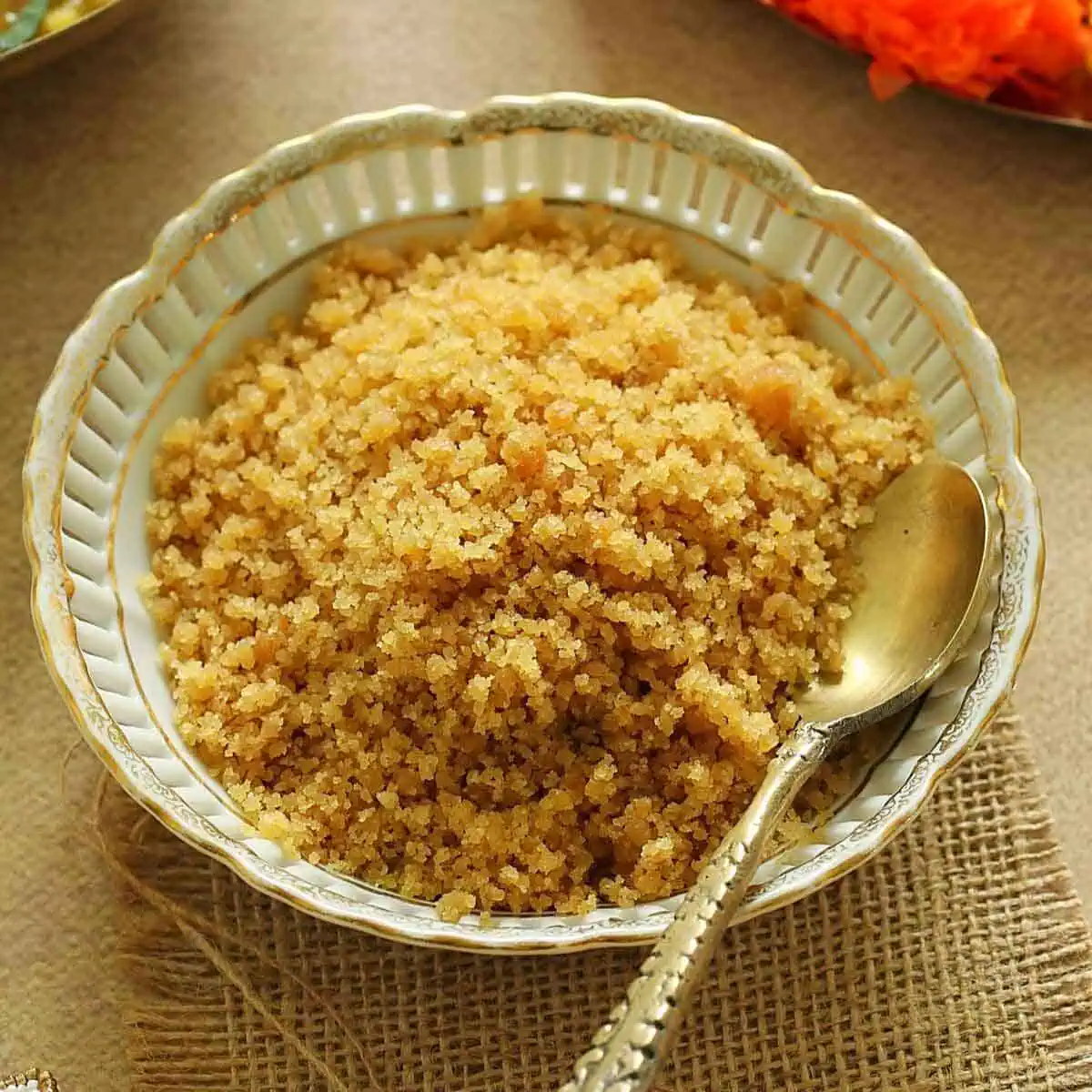
Chutti Lapsi, also known as Kansar, is a traditional Gujarati sweet made on auspicious days like Dhanteras, Diwali, housewarming, and weddings. It uses just a few ingredients: whole wheat flour, jaggery, oil, and ghee. This easy pressure cooker version is quick, healthier than most festive sweets, and has no burnt bottom. Give the moin, keep the flour-to-jaggery liquid ratio right, cool the lapsi, then pulse it into soft, separate grains. Serve it with mug for the classic festive combo.
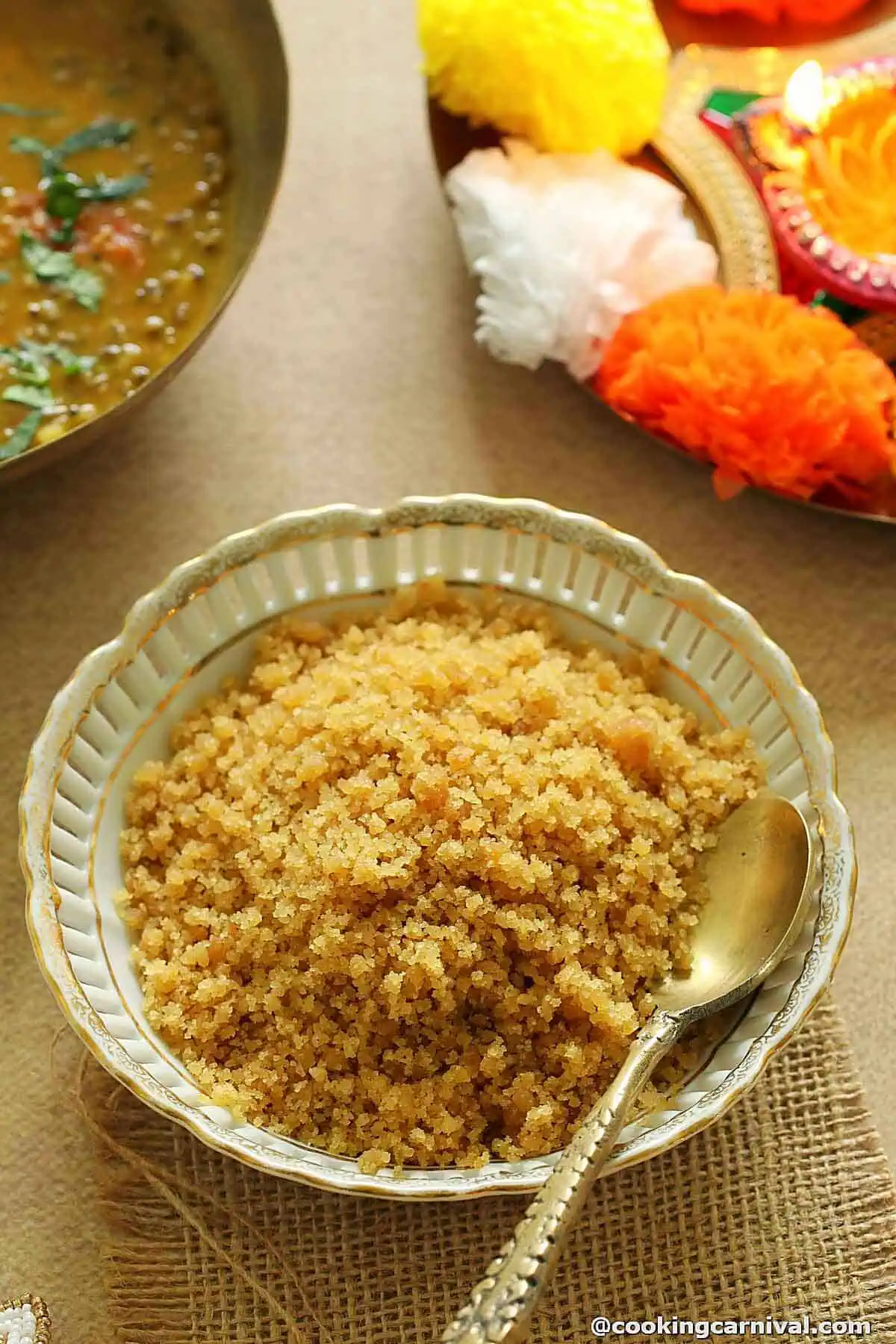
I grew up eating chutti lapsi, and I still make it every year on Dhanteras without fail. With Diwali right around the corner, this is the recipe I am sharing today.
In The traditional method you make the laapsi in a heavy pot and in that you need to make sure the bottom does not burn. Here I use a pressure cooker instead. It is quick, nearly foolproof, and gives you the same soft, melt-in-the-mouth lapsi with no scorched bottom and no standing at the stove.
If you have ever eaten Mug Lapsi at a Gujarati festival meal, you already know why this sweet belongs on the plate. Let me show you how to make it at home.
Jump to:
What Is Chhutti Lapsi (Kansar)?
Chhutti Lapsi is a traditional Gujarati sweet made of loose, separate grains of wheat cooked with jaggery and ghee. "Chhutti" means loose or non-sticky, which is exactly the texture you are aiming for. Kansar is another name for the same sweet.
The names can be confusing, because some families make a sweet with broken wheat (dalia) and also call it lapsi. In most of the gujarati families, that broken-wheat sweet is called Oramu. For us, lapsi means the one I am sharing today.
Lapsi is considered auspicious, so many Gujarati homes make it for festivals and happy beginnings. The occasions I know best are:
- Dhanteras, which is when my family always makes it
- Diwali and Lakshmi Pujan
- Gujarati New Year (Bestu Varas)
- Weddings and the rituals around them
- Griha Pravesh (housewarming)
Customs differ from family to family and town to town, so if your family makes it on a different day, share that in the comments.
Why You Will Love This Recipe
- This version is quick, simple, and hard to get wrong.
- Only a handful of ingredients. Whole wheat flour, sooji, oil, jaggery, and ghee.
- Pressure cooker method. No burnt bottom, no constant stirring.
- Quick. From start to serving, it takes well under an hour.
- A healthier sweet. It uses whole wheat and jaggery instead of refined flour and white sugar. • Festive and auspicious. It suits Dhanteras, Diwali, weddings, and poojas.
Ingredients
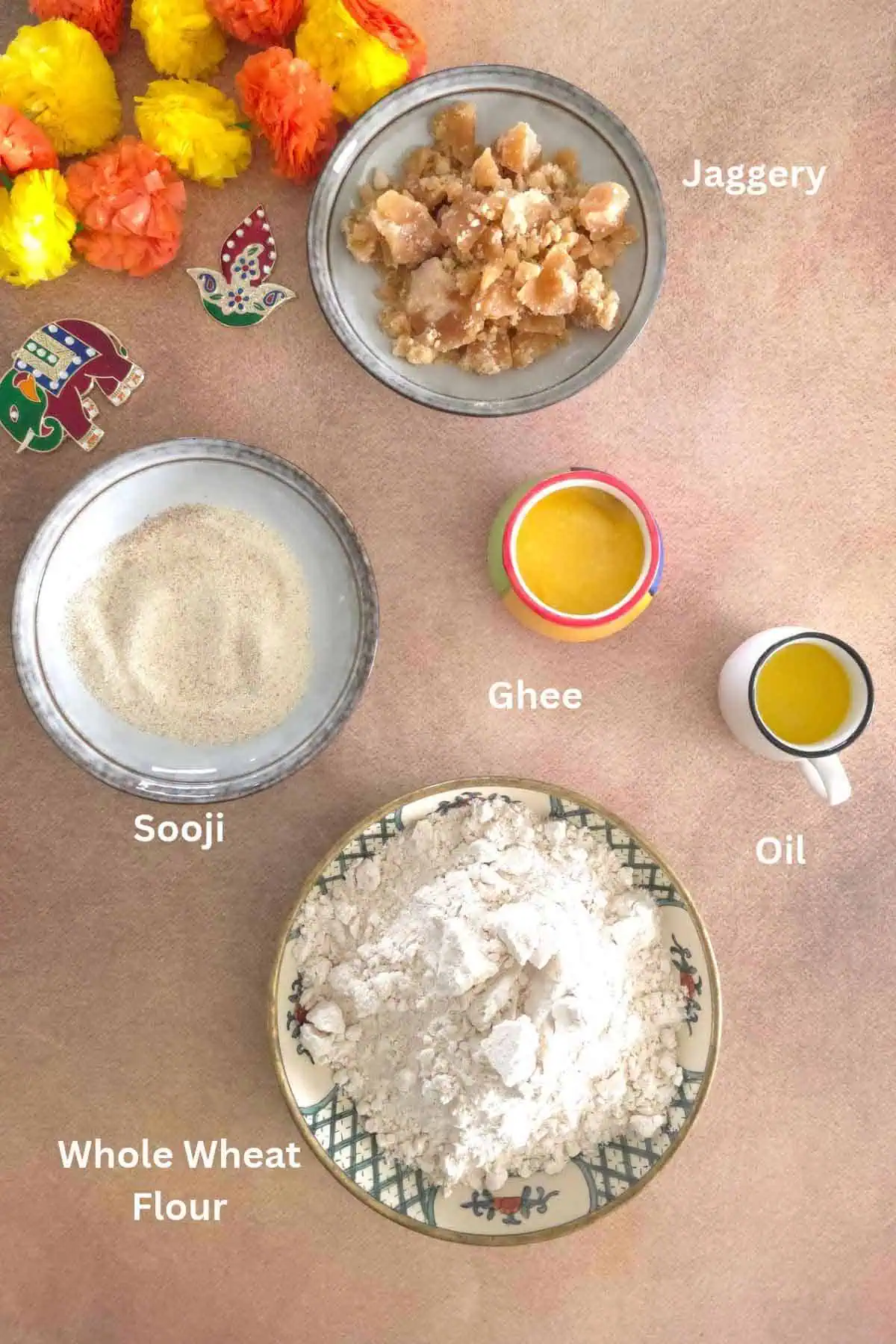
- Whole wheat flour (atta): A slightly coarse atta (bhakhri flour) works best for this recipe. But if you don't have it, use regular chapatti atta, and that's what I used in the recipe. It works completely fine with a little bit of sooji added.
- Sooji: Buy the fine variety.
- Ghee: Use pure ghee, store-bought or homemade, since it is a main flavor here.
- Oil: Any cooking oil works. I use cold-pressed groundnut oil. Jaggery: I use desi jaggery. The color of laapsi depends on the jaggery.
See recipe card for quantities.
Instructions
- Step 1: Give the moin. Mix the atta and sooji in a bowl. Add the oil and rub it into the flour with your fingertips for 2 to 3 minutes. Squeeze a handful. It should hold its shape and then crumble easily. This step makes the lapsi soft, so do not skip it.
- Step 2: Dry roast the flour. Put the flour mixture in a pan and roast it on a low flame for 4 to 5 minutes, until the color changes slightly. Stir continuously so it does not burn. Switch off the flame and keep it aside
- Step 3: Make the jaggery syrup. Put the jaggery and ¾ cup of water in a pot. Heat until the jaggery melts completely. Lower the heat and simmer until the liquid reduces to 1¼ cups.
- Step 4: Mix the syrup into the flour. Pour the hot jaggery syrup over the roasted flour and stir well so there are no lumps. The mixture should feel like a soft dough that is neither sticky nor lumpy.
- Step 5: Transfer the mixture to a bowl and cover the bowl with a lid. Pressure cook. Pour 1 to 2 cups of water into the pressure cooker and place the covered bowl inside. Close the cooker and cook for 4 to 5 whistles on medium heat. Switch off the heat and let the pressure release naturally.
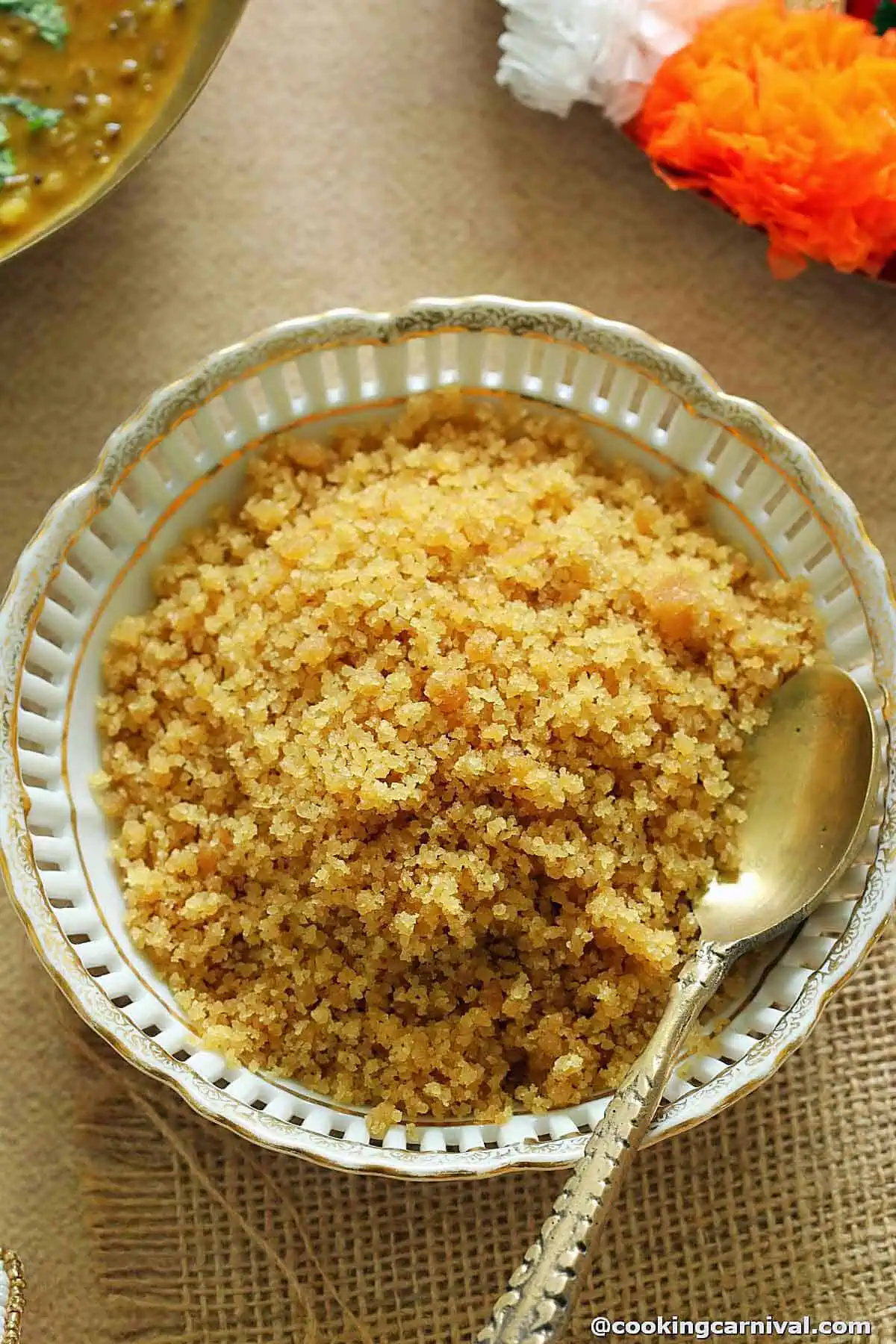
- Step 6: Cool it down. Open the cooker, take the cooked mixture out onto a big plate and let it cool until you can handle it comfortably. Once cooled, break into small chunks, put it in a food processor, and pulse until it looks like coarse sooji, almost like sand.
- Step 7: Put the lapsi on a plate, pour over the hot melted ghee and mix well with your hands.
- Step 8: Serve. Garnish with chopped nuts and rose petals if you wish to. Serve with Mug or eat as is. Enjoy!!
Serving suggestions
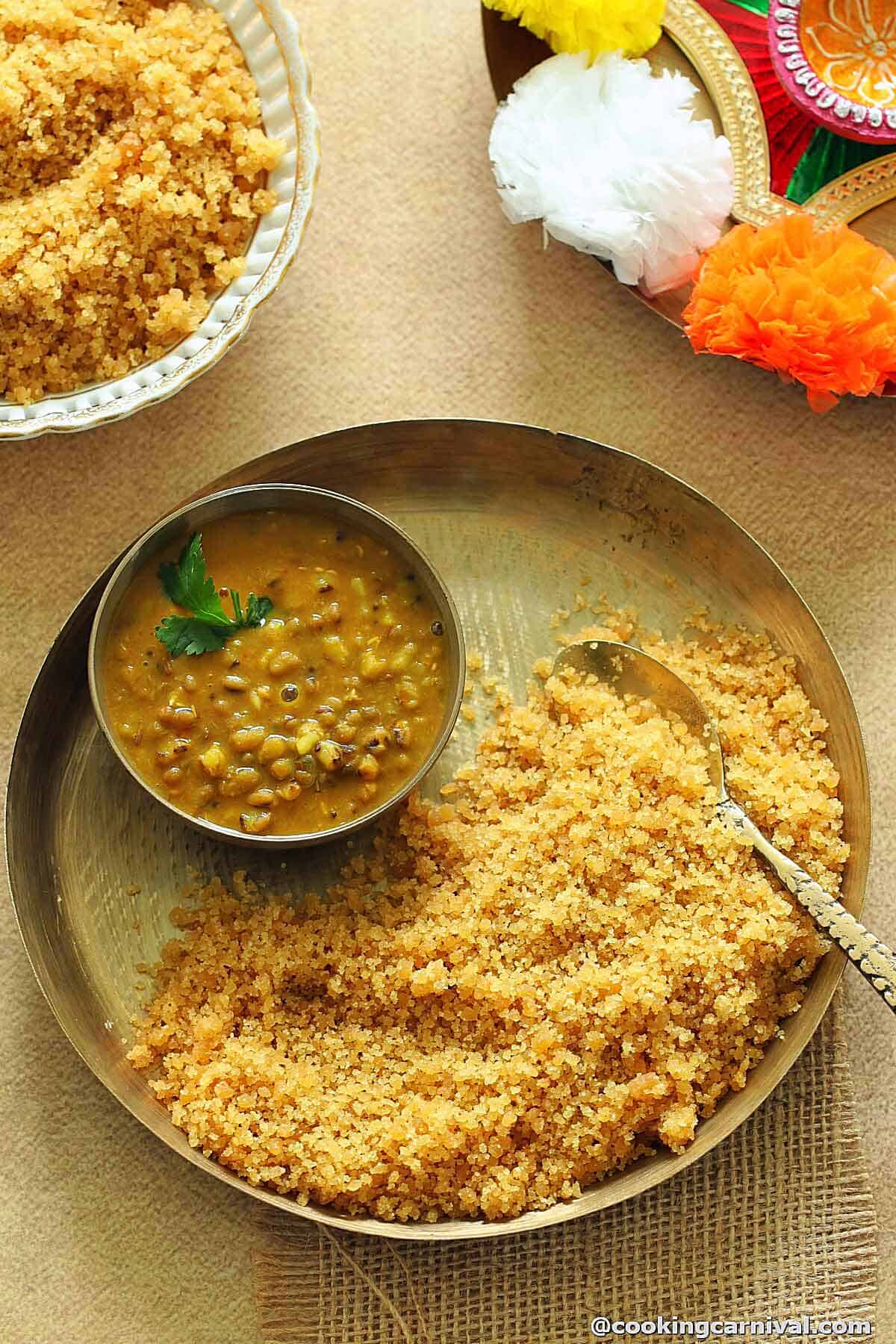
Chhutti Lapsi is best served hot or warm, with an extra spoon of ghee on top. In a traditional Gujarati festive meal, lapsi is paired with mug (whole green moong). Mug and lapsi is a well-known combination made on auspicious days, and the savory, earthy moong balances the sweetness well. Serve a small bowl of each side by side.
Storage
- Chhutti Lapsi tastes best fresh, but it stores well too.
- Room temperature: Keep it in a covered container for up to 1 day.
- Refrigerator: Store it in an airtight container for 1 week.
- Reheating: Warm it in a pan or microwave with a splash of water and a spoon of ghee. Stir gently to keep the grains loose.
- Freezing: It freezes well too. Keep in a freezer-safe container and store in the freezer for up to 3 to 4 months.
Top tip
Optional extras: a pinch of cardamom powder, a pinch of nutmeg, and chopped nuts or almonds for garnish.
Atta-to-jaggery water ratio: I use 1 part flour to a little more than ½ part jaggery water (the liquid) by volume. Too much liquid makes it sticky, and too little makes it dry. Keep this ratio the same if you scale the recipe up or down.
About the sooji: I used regular chapatti atta, so I added a little sooji to get the grainy texture lapsi is known for. If you have bhakhri atta (the coarser flour used for bhakhri), skip the sooji. It is already coarse enough.
Do not skip the moin. Rubbing oil into the flour is the most important step for soft lapsi.
Use ghee generously. Ghee brings out the flavor of lapsi. You can adjust the amount, but I would not leave it out.
Roast on low heat. Roasting too fast gives raw-tasting grains. Wait for the nutty aroma.
Rest before opening. Let the pressure release naturally.
Take the cooked lapsi out of the cooker and let it cool first. Warm lapsi is sticky and clumps instead of separating into grains.
Choose how to make the grains. You can rub the cooled mixture with your hands, or rub it through a ghav chaalvano charno (the sieve used for sifting wheat flour). I prefer the food processor, which breaks the mixture down easily and keeps every grain separate. Use pulse mode in the food processor. Pulse in short bursts and check often. You can use a blender too, on pulse mode.
FAQ
Yes, if you use bhakhri atta, which is coarse enough on its own. With regular atta, the sooji helps give the grainy texture.
Rubbing oil into the flour coats the grains and keeps them separate and soft. Without it, the lapsi can turn hard or pasty.
Yes, in the same quantity. The flavor will be lighter and less earthy, though, and jaggery is what makes this the traditional version.
Yes. Ghee enhances the flavor, so I suggest reducing it slightly rather than removing it.
The usual causes are too much water or too much jaggery.
Sprinkle a spoonful of hot water, and mix it. Add a little more ghee when serving.
Not as written, because of the ghee. You can use vegan butter instead for a vegan version, but the flavor will change.
It tastes best fresh. Make it on the day or the day before and reheat with a little ghee.
Chhutti Laapsi brings back memories of festival mornings in my childhood home, and making it every Dhanteras feels like passing that tradition on. With few ingredients and a pressure cooker, you can make it without the usual fuss
Have you tried this Recipe? Please feed us with your feedback, ★ star ratings, and comments below.
You can also FOLLOW me on FACEBOOK, INSTAGRAM, and PINTEREST for more fabulous recipes and updates.
Subscribe to our YouTube Channel for tasty and easy video recipes.
Related
Looking for other recipes like this? Try these:


Chhutti Lapsi (Kansar) in pressure cooker
Ingredients
- 2 cups whole wheat flour
- ¼ cup Sooji also know as rava, semolina
- 1 cup jaggery grated or small chunks
- ¼ cup oil
- ⅓ cup ghee or as per liking

Method
- Give the moin. Mix the atta and sooji in a bowl. Add the oil and rub it into the flour with your fingertips for 2 to 3 minutes. Squeeze a handful. It should hold its shape and then crumble easily. This step makes the lapsi soft, so do not skip it.
- Dry roast the flour. Put the flour mixture in a pan and roast it on a low flame for 4 to 5 minutes, until the color changes slightly. Stir continuously so it does not burn. Switch off the flame and keep it aside.
- Make the jaggery syrup. Put the jaggery and ¾ cup of water in a pot. Heat until the jaggery melts completely. Lower the heat and simmer until the liquid reduces to 1¼ cups.
- Slowly mix the syrup into the flour. Pour the hot jaggery syrup over the roasted flour and stir well. The mixture should feel like a soft dough that is neither sticky nor lumpy
- Transfer the mixture to a bowl and cover the bowl with a lid.
- Pressure cook. Pour 1 to 2 cups of water into the pressure cooker and place the covered bowl inside. Close the cooker and cook for 4 to 5 whistles on medium heat. Switch off the heat and let the pressure release naturally.
- Cool it down. Open the cooker, take the cooked mixture out onto a big plate and let it cool until you can handle it comfortably.
- Break it into grains. Once cooled, break into small chunks, put it in a food processor, and pulse until it looks like coarse sooji, almost like sand. You can also break it by rubbing it with your hands, or by rubbing it through a ghav chaalvano charno (the sieve used for sifting wheat flour). For me, the food processor works the best.
- Add the ghee. Put the lapsi on a plate, pour over the hot melted ghee and mix well with your hands.
- Serve. Garnish with chopped nuts and rose petals if you wish to. Serve with Mug or eat as is. Enjoy!!
Nutrition
Notes
Private Notes
Tried this recipe?
Let us know We would love to hear your thoughts! Please leave your comments, ratings, and any ideas or changes you think could help us make our recipes even better. Thank you for your feedback!Warm Regards,
Dhwani.



Leave a Reply